
In this article, I’ll dive into the exciting world of 5G technology. It’s the fifth generation of cellular networks and is changing wireless connectivity forever. With 5G, we can expect speeds that are much faster, lower latency, and better connectivity.
This technology is going to open up new possibilities. It will power the Internet of Things (IoT) and make augmented and virtual reality experiences even more real. 5G is set to change how we connect with the digital world.

Key Takeaways
- 5G technology offers significantly faster data speeds, lower latency, and increased network capacity compared to previous generations of wireless communication.
- 5G will enable a wide range of new applications and services, including the Internet of Things (IoT), smart cities, telemedicine, and immersive virtual/augmented reality.
- The deployment of 5G infrastructure and widespread adoption of 5G-enabled devices will drive innovation and economic growth across various industries.
- Addressing security and privacy concerns, as well as overcoming challenges in spectrum allocation and infrastructure deployment, will be crucial for the successful rollout of 5G technology.
- 5G technology is set to revolutionize how we live, work, and interact with the digital world, ushering in a new era of connectivity and digital transformation.
Also Read: AI Revolution: Humanization of the World
What is 5G Technology?
5G is the fifth generation of cellular network technology. It’s a big step up from 4G LTE, offering faster speeds, lower latency, and better network performance. 5G is all about ultra-fast internet, quick responses, and handling lots of devices at once.
Understanding the Next Generation of Wireless Communication
The 5G network is a big deal for many areas, like smart cities and the Internet of Things (IoT). It’s also changing entertainment and healthcare. It brings seamless and reliable connectivity, opening up new possibilities for innovation and tech growth.
Key Features and Enhancements over Previous Generations
5G has some major upgrades compared to older networks, including:
- Faster Speeds: 5G can download up to 10 times faster than 4G, with speeds reaching up to 10 Gbps.
- Lower Latency: 5G cuts down the time it takes for data to travel, making communication almost instant.
- Increased Capacity: 5G can handle a lot more devices, making it perfect for IoT and smart cities.
These improvements in 5G are set to change how we talk, use our devices, and experience the digital world. It’s making our future more connected and efficient.
The Revolutionary Impact of 5G Technology
The launch of 5G technology is set to change many industries and our daily lives. It brings faster data speeds, lower latency, and more reliable connections. This means we can do things we couldn’t before.
It will make autonomous vehicles and smart factories possible. It will also improve immersive AR/VR experiences and change telemedicine. 5G technology will change what we think is possible in the digital transformation.
5G offers fast speeds, low latency, and better reliability. It opens doors to new technologies and 5g use cases we can’t imagine yet. From remote surgery to managing traffic in real-time, its potential is endless.
Unleashing the Potential of the Internet of Things (IoT)
5G technology is set to change the Internet of Things (IoT) world. It will make connecting billions of devices seamless. With its fast speed, low delay, and support for many devices, 5G will unlock IoT’s full potential in many fields.
5G will make it easy to link up 5g technology iot devices like smart home gadgets and industrial sensors. This will lead to new, efficient solutions. These will make life better and drive digital change.
Enabling Seamless Connectivity for Billions of Devices
The internet of things is growing fast, with over 75 billion devices expected by 2025. But old wireless tech couldn’t keep up with this growth. 5G’s advanced features will provide the strong, reliable connection needed for smart home and smart city tech.
| Key Advantages of 5G for IoT | Impact on IoT Applications |
|---|---|
| High-Speed Data Transmission | Enables real-time data processing and analysis for time-critical IoT use cases |
| Ultra-Low Latency | Supports mission-critical IoT applications that require instant response times |
| Massive Device Connectivity | Accommodates the rapid growth of connected devices in smart homes, cities, and industrial environments |
With 5G, the internet of things will get a huge boost. This will open up new chances for innovation and digital change in many areas.
Also Read: AI Revolution 2025: How is it completely transforming sectors and societies?
5G Technology: Powering the Future of Smart Cities
The introduction of 5G technology is changing the game for smart cities. It allows for a huge network of devices and sensors to work together. This makes cities more efficient and intelligent.
5G will make cities better in many ways. It will help manage traffic and energy use. It will also make cities safer and provide real-time data for planning.
Efficient Urban Infrastructure and Intelligent Services
5G networks will change how cities work. They will make traffic flow better by monitoring and managing it. This means less traffic and easier travel.
5G will also make energy use better. It will help manage energy in a smart way. This means cities will use resources more efficiently.
Also Read: Tech for Seniors
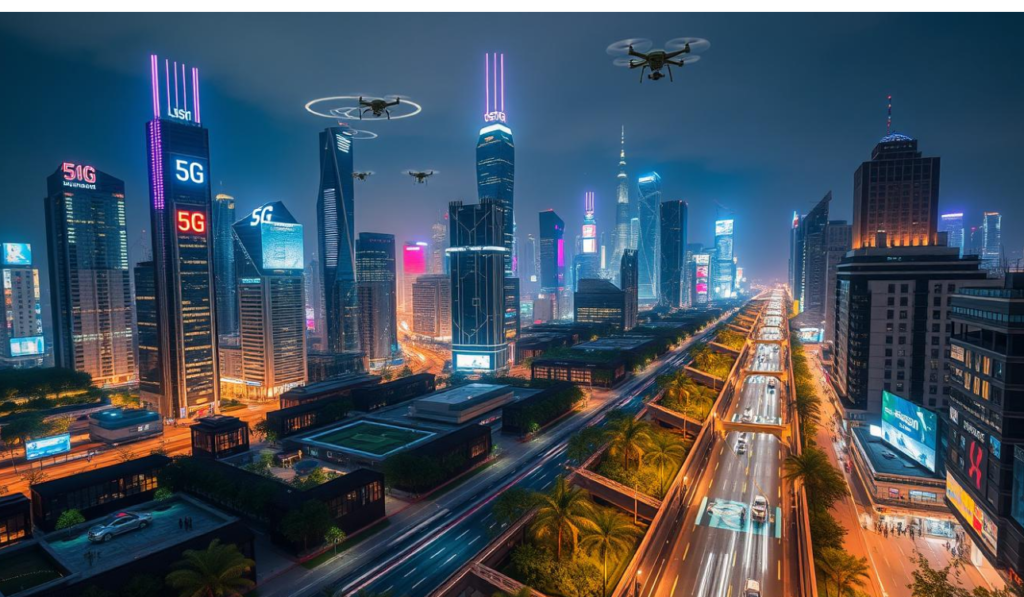
A vibrant futuristic cityscape illuminated at night, showcasing sleek skyscrapers adorned with glowing 5G antennas and digital displays, autonomous vehicles navigating smart roads, green spaces integrated with technology, drones flying overhead, and people interacting with augmented reality interfaces in a dynamic urban environment.
5G will bring many new services to cities. It will improve public safety and emergency responses. It will also help with waste management and keeping an eye on the environment.
5G in Healthcare: Transforming Telemedicine and Remote Care
The healthcare industry is on the verge of a big change with 5G technology. This new wireless standard will change how we do telemedicine and remote care. It will make video calls in real-time, connect medical devices smoothly, and monitor patients from afar.
Imagine patients in far-off or hard-to-reach areas getting top-notch healthcare easily. 5G will make it possible for patients and doctors to connect better. This will make healthcare more efficient and fair for everyone, saving money and improving health outcomes.
5G will also help doctors give more tailored and timely care. With devices that send health data in real-time, doctors can spot and fix problems fast. This leads to better care and quicker help when needed.
The impact of 5G on healthcare is huge. It will make quality care more available and efficient. As technology and healthcare merge, 5G will be key in shaping the future of healthcare.
5G Technology: The Game-Changer for Augmented and Virtual Reality
5G technology is changing the game for augmented reality (AR) and virtual reality (VR). It offers ultra-low latency and high-bandwidth connectivity. This means we can expect new levels of immersive experiences and real-time interactions.
Immersive Experiences and Real-Time Interactions
Thanks to 5G, developers can make AR and VR apps that are seamless and engaging. The low latency of 5G makes sure actions in the virtual world happen fast. This creates immersive experiences that feel real and natural.
Also, 5G’s high-bandwidth lets us see high-quality, stunning content. This makes virtual reality environments clearer and more detailed. It opens up new chances in gaming, entertainment, education, and remote work. Users can now interact with digital content in more fun and intuitive ways.

A futuristic cityscape featuring people using augmented and virtual reality devices, vibrant holographic displays, and interconnected 5G network towers seamlessly integrating with the urban environment, showcasing advanced technology and immersive experiences.
5G’s low latency connectivity and high-bandwidth make AR and VR more accessible. This leads to a new era of immersive experiences. It changes how we see and interact with the digital world.
The Rise of Edge Computing and Low Latency Applications
The arrival of 5G technology is set to make edge computing more common. Edge computing moves data processing and storage closer to where the data is. This cuts down on latency and makes things more responsive. With 5G, we’ll see new low-latency applications like self-driving cars and smart factories.
Edge computing with 5G means we can handle real-time data locally. This is better than using a cloud because it’s faster. It’s perfect for 5G use cases that need quick responses, like remote surgeries and drone control.
| Key Advantages of 5G Edge Computing | Impact on Various Industries |
|---|---|
| Low latency for real-time applications Improved data processing capabilities at the edge Reduced bandwidth requirements for data transmission Enhanced privacy and security by keeping data local | Autonomous vehicles and transportation Industrial automation and smart manufacturing Remote healthcare and telemedicine Surveillance and public safety Augmented and virtual reality applications |
As 5G grows, so will the partnership between 5G and edge computing. This will bring us a new wave of low-latency, real-time applications. These will change many industries and open up new possibilities for 5G.
Addressing Security and Privacy Concerns in the 5G Era
As 5G technology spreads, we must tackle security and privacy concerns. 5G brings more connectivity and data flow, raising risks of cybersecurity threats, data breaches, and privacy issues. It’s vital to design 5G networks with strong security measures, encryption, and data protection protocols to keep users and their data safe.
Working together, industry, policymakers, and security experts can tackle these challenges. 5G standards need to focus on network security and data protection. This will help build trust and encourage more people to use 5G.
As 5G networks grow, we must tackle privacy concerns early on. We need strong safeguards and clear data management to protect personal info. This way, we can enjoy 5G’s benefits without risking our data protection.
Overcoming Challenges: Spectrum Allocation and Infrastructure Deployment
The adoption of 5G technology examples several challenges. One major issue is finding enough radio frequency spectrum. This spectrum is needed for 5G’s high-bandwidth and low-latency features. 5G deployment challenges like this must be solved for 5G to reach its full potential.
Also, setting up the necessary infrastructure investment for 5G, like cell towers and small cells, needs teamwork. This includes telecom providers, governments, and regulatory bodies. Creating the right regulatory framework is key for a smooth and wide 5G rollout.
Paving the Way for Widespread 5G Adoption
Effective policymaking and teamwork are essential to overcome these hurdles. Spectrum allocation and smart infrastructure deployment are the first steps. They will help make 5G a widespread and transformative technology.
5G Technology: Driving Innovation and Economic Growth
The arrival of 5G technology is set to usher in a new era of prosperity and innovation. It will bring faster data speeds, lower latency, and more reliable connections. This will open doors to cutting-edge applications and services across industries.
5G will deeply impact sectors like manufacturing, healthcare, transportation, and entertainment. It will create new job opportunities and boost economic growth.
As 5G technology spreads, it will be a key driver for the digital economy’s future. The 5G benefits like increased productivity and industry transformation will put nations at the forefront of tech innovation. Businesses will use 5G to create new models, improve efficiency, and enhance customer experiences.
The 5G economic impact will be huge, opening new paths for innovation and economic growth. Governments and industry leaders are investing in 5G infrastructure. They see its potential to change sectors and drive sustainable growth.
| Potential 5G Benefits | Impact on Specific Industries |
|---|---|
| Increased productivity Enhanced connectivity for IoT devices Enabling new business models Reduced latency for real-time applications | Smart manufacturing: Optimized production and supply chains Healthcare: Improved telemedicine and remote patient monitoring Transportation: Autonomous vehicles and intelligent traffic management Entertainment: Immersive augmented and virtual reality experiences |
The future looks bright for 5G technology and its role in transforming industries, driving innovation, and boosting economic growth. As we move into this new era of wireless connectivity, we can expect exciting advancements and new opportunities. These will shape the digital landscape.
Conclusion
As we move into the digital transformation era, 5G technology is a major leap forward in wireless connectivity. It promises to change how we interact with the world. This includes making the Internet of Things work seamlessly and improving healthcare and immersive experiences.
The effects of 5G will be huge, making smart cities smarter, powering new apps, and boosting the economy. But, we face challenges like spectrum allocation and building out the infrastructure. Still, 5G’s adoption will open up new possibilities and change the digital world for the better.
By embracing 5G, we can enter a world with better connectivity, more efficiency, and endless opportunities. This technology will change our daily lives and lead to a more connected and innovative future. The only limit will be our imagination.